Churches and Monasteries in Tur Abdin – a Cultural Heritage Worth Preserving and Protecting
Tur Abdin – a dry, hilly highland in present-day southeastern Turkey, situated between the Tigris to the north and east and the Syrian border to the south – is regarded as one of the oldest areas of origin and, at the same time, one of the last settlement areas of the Aramaic Christians. The Christian faith was already being proclaimed here in the 2nd century. The oldest Christian house of worship, located in Edessa (Urfa, Urhoy), is dated to the 2nd century; it is said to have been destroyed by a flood in 201. The oldest church that can so far be dated with certainty, from the year 372, is found in Antioch. The earliest monastery was established in Karakilise (Kankrit), about 8 km southwest of Amid/Diyarbakir on a hill, and can already be documented as early as the middle of the 2nd century.
From the 4th century onwards, monks finally led Tur Abdin to Christianity. This was accompanied by the establishment of monasteries in almost every settlement. In addition, hundreds of churches were built, especially beginning in the 5th/6th centuries. Above all, the monasteries were centers and bearers of culture, with their many scribes who wrote down and passed on Syriac liturgical as well as literary texts. On this basis, they were also important educational institutions and homes of flourishing art and culture throughout the centuries. Important monasteries were and are: Dayro d’Zahfaran (4th/6th century) 8 km east of Mardin, Mor Gabriel (397) near Midyat, and Dayro d’Mor Yakup (419) near Salah. The large church (Mor Jacob) in Nisibis was also built early in the 4th century, within seven years, by Mor Jacob of Nisibis († 338). It can therefore be stated that the oldest Christian places of worship arose in Aramaic/Syriac territory.
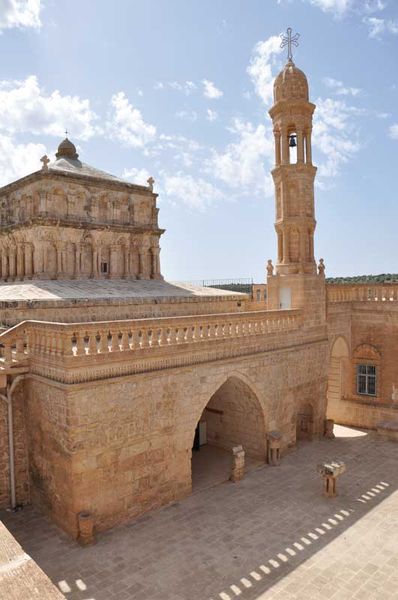
The churches and monasteries of Tur Abdin, including the many that now exist only as ruins, are the stone witnesses to the eventful history of this region. After the first flourishing under Byzantine rule, church and monastery construction went through changing phases following the conquest of Byzantium, and thus also of Tur Abdin, by the Arabs at the beginning of the 7th century. Alongside periods of restriction, the aftermath of the schism of the Church brought extensive phases of construction favored by Arab rulers, during which many new monasteries and churches were built. This also marks a turning point in architectural history, dividing church buildings into the periods before and after the Arab conquest. Following these relative periods of flourishing, however, numerous monasteries and churches were destroyed, particularly during the major historical upheavals in Tur Abdin. These included the devastation caused by the Mongols between the 12th and 14th centuries and by the Kurds in the 15th century, the genocide during the First World War with its devastating consequences, and the Kurdish uprising of 1924–28 against the Turks, during which the Kurds barricaded themselves in monasteries and churches that were shelled by the Turks.
But although an immense amount was destroyed over the centuries and many Christian villages were abandoned through the exodus of the Aramaeans, churches and monasteries were also rebuilt, often restored, renovated, altered, and newly constructed. As a result, even today there are churches and monasteries dating back to the earliest centuries in which prayers are said and worship is celebrated in the Aramaic language; in which ancient baptismal fonts still stand, connecting generations and symbolizing the unity of spirit and stone, and which constitute a very important part of the homeland for the majority of Aramaeans who now live in the diaspora.
Since the 1990s, there have been increased efforts to counteract the deterioration of the monasteries and churches that still exist, a decline accelerated above all by the exodus in the 20th century. Many emigrants return to their homeland in the summer, restore and renovate their village churches, and hold services there. Thus, with the help of communities or community members living in the diaspora, churches in a number of villages have already been lovingly restored and returned to service. They are regarded and embraced as historical roots, heritage, and an anchor to their homeland. This process continues and represents an important contribution to preserving the churches and monasteries as a living heritage for the Aramaeans.
But they are not only this for the Aramaeans. Due to their age, their historical and religious significance, as well as their great diversity and beauty, the churches and monasteries of Tur Abdin, together with the more than three-thousand-year-old Aramaic language, are a unique and therefore indispensable part of the world’s cultural heritage that is worthy of protection and preservation. One of the most significant witnesses to this fact is the British research traveler and expert in sacred architecture, Gertrude Bell (1868–1924), who in 1910 saw in the monastic churches of Tur Abdin the last representatives of an ancient Oriental architectural style, in which the ancient design of a Babylonian temple or a palace hall has been preserved.
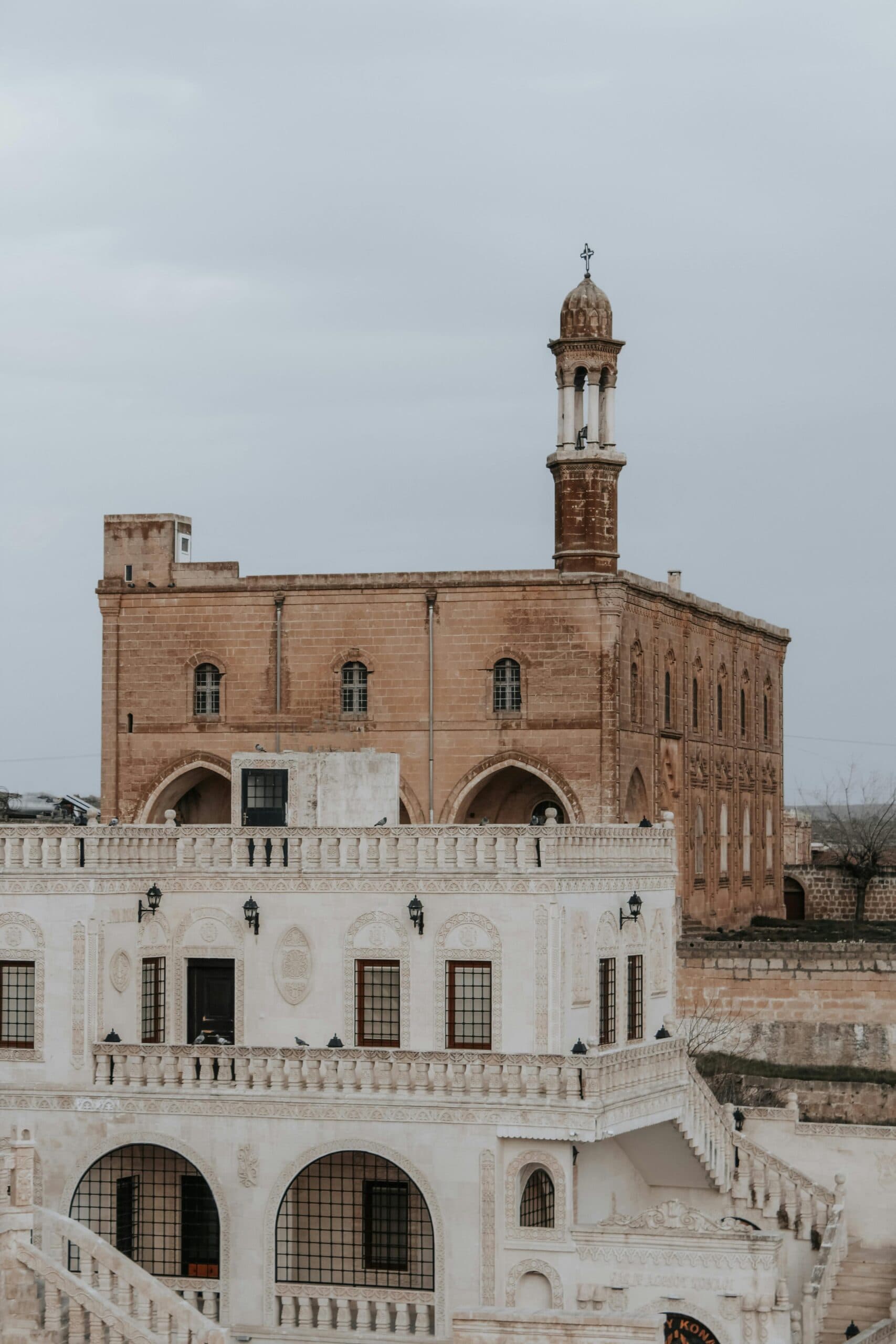
The renewed threat to parts of this cultural heritage posed by the Turkish confiscation of more than fifty monasteries and churches in Tur Abdin in 2017 prompted the “Foundation for the Preservation and Promotion of Aramaic Cultural Heritage” to contribute to further publicizing this world cultural heritage and to draw attention to its continuing threat. In 2021, nine churches and monasteries of Tur Abdin – including three ruins – were included in UNESCO’s Tentative List of World Heritage. This means that the threat has not yet been averted, especially since, on the Turkish side, the promotion of tourism is the primary factor behind this step. Nevertheless, it is an important step in the right direction. The exhibition, which presents a small part of this wealth in contemporary photographs, is intended to further promote this effort. At the same time, it is intended to give the people of Tur Abdin a sense of home, strengthen their pride in this significant heritage, and encourage them to continue contributing to its preservation. We call upon everyone who views this exhibition to do so as well.