Explore the historical continuity of our people: Aramean Timeline →

Arameans
Digital Archive

Aramean Continuity

Aramean Timeline

Prism Q005926
Archeology Artifactc. 1114–1076 BC

Prism Q005926

Tiglath-pileser ITiglath-pileser I

"With the support of the god Aššur, my lord, I took my chariots and warriors (and) set off for the desert. I marched against the Arameans, the enemies of the god Aššur, my lord." As seen in Prism Q005926 by Tiglath-pileser I, the Arameans constituted a threat to the Assyrian kings. In this prism, Tiglath-pileser I called upon the Assyrian pagan deity Aššur.

Kurkh Monoliths
Archeology Artifact852 BC

Kurkh Monoliths

Shalmaneser IIIShalmaneser III

"Karkar, his royal city, I destroyed, I devastated, I burned with fire. 1,200 chariots, 1,000 cavalry, 20,000 soldiers, of Hadad-ezer, of Aram; 700 chariots, 700 cavalry, 10,000 soldiers of Irhulêni of Hamath; 2,000 chariots, 10,000 soldiers of Ahab, the Israelite." The Stele of Shalmaneser III describes his military campaigns in western Mesopotamia and Syria. It describes Shalmaneser’s victory at the battle of Karkar, situated in northern Syria, where he overthrew an alliance of 12 local kings. Shalmaneser had inscribed on the monolith:

Stele of Zakkur
Archeology Artifact805 BC – 775 BC

Stele of Zakkur

Henri PognonHenri Pognon

"I am Zakkur, king of Hamath and Luash... Bar-Hadad, son of Hazael, king of Aram, united against me seventeen kings... all these kings laid siege to Hazrach... Baalshamayn said to me, 'Do not be afraid! ...I will save you from all [these kings who] have besieged you.'"

Sefire Steles
Archeology Artifact8th century

Sefire Steles

Sefire StelesSefire Steles

"The treaty of Bar-Ga'yah, king of KTK, with Mati'el, the son of 'Attarsamak, the king [of Arpad; and the treaty] of the sons of Bar-Ga'yah with the sons of Mati'el; and the treaty of the grandsons of Bar-Ga'[yah and] his [offspring] with the offspring of Mati'el, the son of 'Attarsamak, the king of Arpad; and the treaty of KTK with [the treaty of] Arpad; and the treaty of the lords of KTK with the treaty of the lords of Arpad; and the treaty of Ha[bur]u with all Aram and with Misr and with his sons who will come after [him], and [with the kings of] all Upper-Aram and Lower-Aram and with all who enter the royal palace." The Sefire Steles document the treaties between Mati'el of Arpad and the king of KTK, mentioning "all Aram" and "Upper and Lower Aram," directly referencing the geographical and political expanse of Aramean influence.

Inscriptions by Sargon II
Archeology Artifactc. 760–d. 705 BC

Inscriptions by Sargon II

Sargon IISargon II

"(As for) the rest of the dangerous Arameans who dwell in their district (and) who had paid attention (lit.: “inclined their cheek”) to Marduk-apla-iddina (II) (Merodach-Baladan) and Šutur-Naḫūndi and taken (themselves) to the Uqnû River, a far-off place to live (lit.: “a distant dwelling”)," "... I received substantial ... from ...] the land Aram, the land Bīt-Amukkāni, [the land Bīt-Dakkūri, ...]." "While I was br[inging about] the defeat of the Chaldeans (and) Arameans of the Eastern Sea" These inscriptions show that, in Sargon II’s own annals, the Arameans were regarded as a dangerous enemy, with the land of Aram and its subprovinces Bīt-Amukkāni and Bīt-Dakkūri explicitly named as hostile regions.

Receipt for a Grain Loan
Manuscript402 BC

Receipt for a Grain Loan

In December 402 B.C.E., Ananiah, son of Haggai, borrowed two monthly rations of grain from Pakhnum, son of Besa, an Aramean with an Egyptian name. This receipt would have been kept by Pakhnum and returned to Ananiah upon repayment of the loan. No interest was charged on the loan, but a penalty was imposed for failing to repay it by the appointed date.

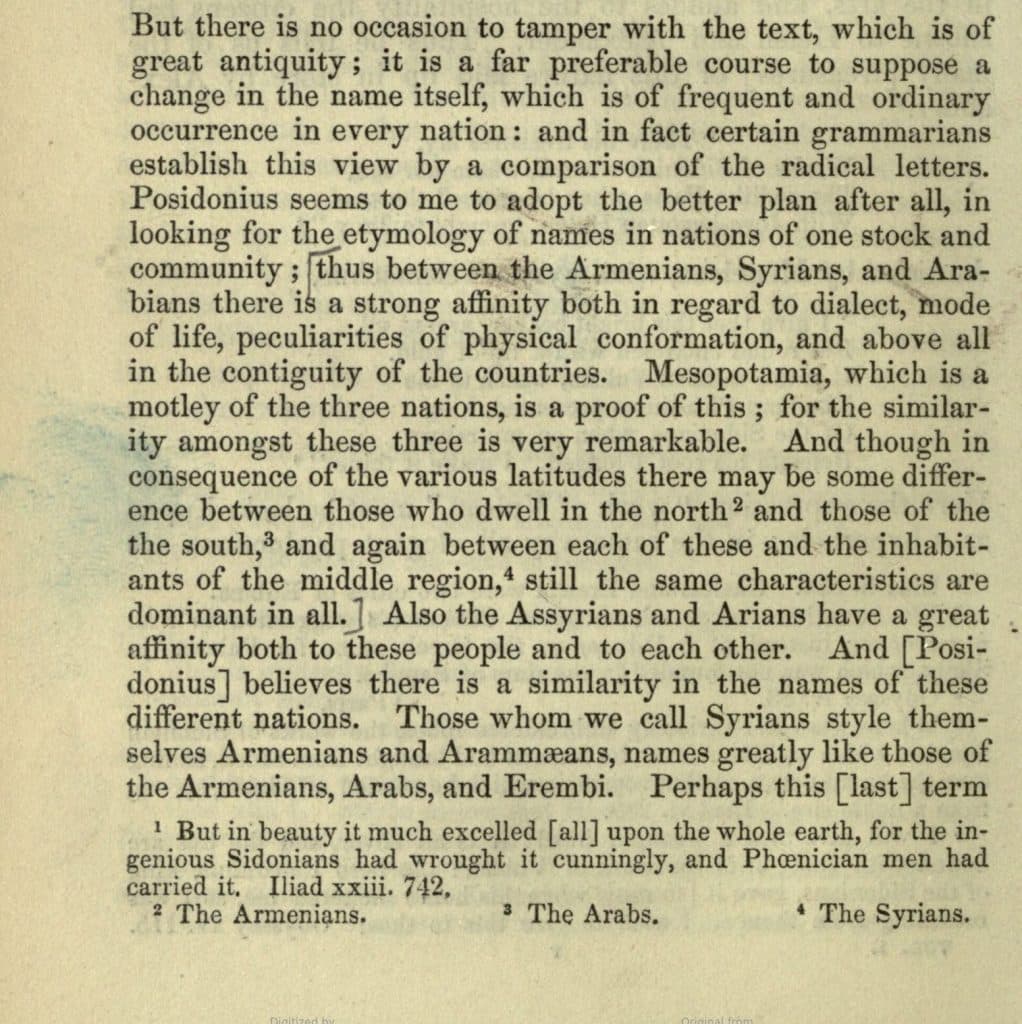
The Geography of Strabo
Encyclopedia63 BC – 24 AD

The Geography of Strabo

StraboStrabo

"Poseidonius conjectures that the names of these nations also are akin; for, says he, the people whom we call Syriacs are by the Syriacs themselves called Arameans."

Hymns on Abraham Kidunaya and Julianos Saba

Saint Ephrem the Syrian sang the praises of Aram. He prized her even above ‘her companion’ land, as Ephraem calls the historical ‘Holy Land’, and he addressed Aram directly as he spoke of the glories of her saints whose festivals were resounding within her as he wrote. He said, "May myriads of tongues give thanks for our country, in which Abraham and his son Jacob walked, Sarah, Rebecca, Leah and Rachel too, even the eleven chiefs of the tribes. It was out of your treasury Zion grew rich in the sons of Jacob. Our country’s name is greater than her companion’s name, for in her Levi, the chief of the priests, was born, Judah too, the chief of the royals, and Joseph, the child who went on to become the lord of Egypt; in light from you the whole world is alight. For the new sun which has arisen in creation, from Judah, who was born in our country, has also risen and been reflected within our country, albeit he made his light shine from Bethlehem. Since from you the beginning shone forth, in you too is the end enriched."

A Letter on Barsauma, pt. 2

"In the days of Babai the Catholicos, this Mari emerged as the teacher of the heresies of the followers of Paul of Samosata and Diodorus [of Tarsus] in Beth Oromoye (land of the Arameans). And Babai the Catholicos, the son of Hormizd, who was the secretary of Zabercan, the Marzban of Beth Aramaye, received the doctrine from him. Anyone who does not confess that Mary is Theotokos, let him be anathema!"

A Letter on Barsauma, pt. 1

"Acac the Aramean, who was called 'the suffocator/oppressor of farthings' at the very school (of Urhoy/Edessa). ... Mar Benjamin the Aramean, who later became the abbot of the school in the village of Daira, which (lies) in the diocese of our monasteries."

Mor Jacob of Serugh Hymnal

"And how did the son of a donkey carry him? Zion denied, and the Church confesses, in his death is life by which she was saved. Blessed is Christ who uprooted Zion, who loved the calf and thirsted for blood, and chose the Church, daughter of the Arameans, in his death is life by which she was saved. Blessed are the children, blessed are the children who were worthy to see Christ, when he entered Jerusalem riding on a borrowed, stripped colt."

About Simon the Apostle's net

"Simon's net is the Church, daughter of the Arameans, and as in the night, in the world, she labored in vain." In this passage, Saint Jacob of Serugh describes the Church as the daughter of the Arameans.