
Origins and Migration (17th Century)
The Safar family, a prominent Syriac Orthodox Christian lineage, originated in the village of Ka‘biye, a village outside Diyarbakir, and migrated to Midyat in the 17th century. By the late 19th century, they had become one of Midyat's largest and most influential families, with their heads exerting significant sway over church affairs, Ottoman government relations, and Dekşurî confederation policy. Their history, as preserved in unpublished memoirs such as the Arabic-language Sayfō Rabō (The Great Seyfo) and in correspondence from the Syriac Orthodox Patriarchate archives, reveals how Syriac Christians actively participated in tribal structures, wielding power beyond the confines of the millet system. This challenges scholarly interpretations that often portray Syriac-Arameans as passive or excluded actors amid the violence and persecution of the era, highlighting instead the complexities of social relations in a period of Ottoman centralization and intercommunal tension.
Archival sources and memoirs from the late 19th and early 20th centuries, including the history of the Safar family of Midyat—the senior Christian family of the Late Ottoman Dekşurî Confederation and the most influential family of Midyat’s Late Ottoman Christian community—offer hitherto unexamined details on how Christians operated within the tribal structures of Tur Abdin, demonstrating both the power they wielded and the limits to their advancement. Thus, the Safar family history shows how Syriac-Arameans were not simply passive actors who wielded power only within their Syriac Orthodox millet, but that understanding the period through the millet system overlooks the ways Syriac-Arameans exercised power within tribal politics. As a consequence of the violence and persecution endured by Syriac-Arameans during the Late Ottoman period, scholars have often interpreted Syriac-Arameans as not fully participatory in tribal structures, instead seeing them as either excluded or powerless within tribal affairs. These memoirs and archives shed light on how, while acknowledging their generally vulnerable status, such beliefs reflect the collapse of social relations in the Late Ottoman period and obscure the complexities of social history.
Atrocities and Exile (1855)
Atrocities by Ezdînşer Beg against Tur Abdin and Midyat included the elimination of the Beth [house of] Safar, a family who became central to the region’s narrative in the late 19th century, and whose importance is not adequately reflected in its historiography. The family, whose heads were highly influential on both church, government, and Dekşurî policy in the region, originated from Diyarbakir and migrated to Midyat in the 17th century, becoming one of the largest families in the city.
They killed Antar Safar, and the young man Melke Bate, and harassed the priest Karim of ʿAinwardo so severely that he threw himself into the [village’s] cistern. The murder of Antar Safar sets in motion the flight and triumphant return of the Safar family, who become central figures in the history of late 19th century Tur Abdin. In a letter to the Patriarch in 1881, members of the Safar family write to reclaim the wealth they had left behind a generation before, stating “in the year of Ezdîn Şêr [1855] we fled to Diyarbakir, where we remained, yet our house remained in Midyat.” Claiming that in their absence their property was sold illegally, and that they were abused by other prominent Christians of Midyat when attempting to retrieve payment for it, they cite their support on the matter by Matran Shem`un, the local bishop, and ask for the Patriarch to pressure members of Midyat’s other prominent Christian families to pay them. However, what is not reflected in this record is the contemporary efforts by the Safar family to establish near-feudal hegemony over Midyat. The most revealing source of this trend is an unpublished Arabic-language family memoir, entitled Sayfō Rabō [The Great Seyfo], which provides historical details as well as attitudes regarding the perceived role of the Safar family within both tribal-state relations and intra-tribal relations. Although the text centers on the achievements of the Safar family, it often, and very openly, presents the resentment of Christian families against the Safars. Most important, however, is the manner in which it indicates that Christians played central roles in Tur Abdin’s major events of the late 19th century, not solely as passive victims of violence, and that complex tribal relations were the primary factor in dictating events, rather than simple religious boundaries and hierarchies.
Reconquest and Leadership (1864)
After the events of 1855, tribes from Botan still preserved their authority in the region. It was not until 1864 that the area was fully recaptured through an allied force of Ottoman regular army and Dekşurî militias. Within the memoir, the narrative of the recapture is presented by a figure who refers to himself as “Safar al-Abidin.” According to him, during Ezdinser Beg’s capture of Midyat, only two figures from the Safar family were able to escape: Safar ibn Safar Agha and Barsoum Agha. Safar Agha was accompanied by a Êzîdî servant named Hemo whom he gained control of after rescuing him from execution. The pair were reportedly seen as formidable figures, with Hemo at one time freeing the two from jail in Diyarbakir by loosening their cell’s iron bars, and that Safar’s demeanor and reputation were so terrifying as to cause “some to urinate when he stared them down.” The memoir often notes the closeness between Safar and the Êzîdî community, stating, for example that Safar Agha was known to carry a walnut wood pipe which he received as “a gift from the Yezidis of Sinjar,” and that two of his closest companions aside from Hamo were a Êzîdî servant named Suluki and a Êzîdî bodyguard named Mousli, to whom he later entrusted political power. During his exile, first in Diyarbakir and later traveling to Constantinople, Safar Agha was able to receive the attention of the Sultan through the intercession of the Patriarch in Mardin and by a request from Matran Paulus, the Patriarchate’s representative in the capital. During this meeting, Sultan Abdulaziz, impressed by Safar’s story, pledged to send an Ottoman army detachment to support Safar and his allies in “expelling the invaders [who have come] from Jazira ibn Omar.” As becomes the case in Safar’s later dealings with Protestants and other rival communities, the discourse of foreigner and outsider is central to his claim of local authority.
Safar traveled to Midyat to begin preparations for the reconquest of Tur Abdin. The Patriarch reportedly gave a sermon to rally support around Safar Agha, ordering them: “Unify your words, close your ranks and obey our son Safar, whom the government has given full authority to wage war” against those who have terrorized the region. Shortly after an Ottoman military contingent arrived, whose leader Osman Pasha Berik issued Safar Agha a medal from the Sultan, praising the Syriac-Aramean community’s “example of true citizenship, peace and dedication” to the Ottoman government since its inception. With these reinforcements, Safar was then able to gain the support of the region’s other various Syriac-Aramean elite, such as heads of the Grigo and `Ajjo families, and the “tobacco smoking” matriarch of the Saido family who give the force tactical advice on coordinating between irregular Syriac-Aramean militias and regular Ottoman units. The Saido was itself a branch of the Safar family. In final preparations, he then bolstered the morale of his community on the eve of battle by giving a speech stating “we were able to withstand over 24 centuries in the face of challenges of various peoples, empires, kingdoms and barbarians,” declaring the Syriac-Aramean community’s indigeneity and resilience against outside aggression. Safar Agha continued: “We did not lose our Syriac identity nor abandon our sacred language or beloved dialect, we did not abandon our customs and traditions and did not reject our faith” those who died are martyrs, and must be merciless in protecting their customs and religion from annihilation. The Syriac-Ottoman army began their operation on June 17th, 1864. This force was quickly joined by a variety of the region’s non-Syriac communities. Safar Agha received word that the Êzîdîs of Bab al-Jannah and Kafrnas “did not want to become involved in an event that did not concern them, but do not want to deepen enmity,” and so a smaller contingent of Êzîdî forces volunteered to join. While noting that local Kurds “are loyal to their word but are still religious fanatics,” various Kurdish groups joined Safar Agha’s army. Most notably, as is important for the subsequent six decades of tribal relations in the region, is that Mala [House of] Osman, the most important family of the Heverkan, decided to join in this mostly Dekşurî force. Within the memoir, Safar Agha portrayed his appreciation to them for having protected Christian holy sites in Tur Abdin during the previous three decades but notes the long-standing animosity between them is deep rooted. During the battle, in which the Botani are driven out over a multi-day fight, Safar’s Êzîdî servant Hemu demonstrated his bravery, while Safar Agha’s first-born son was carried wounded off the field. His removal from the battlefield was interpreted by Safar Agha as an act of cowardice – a transgression severe enough to revoke his birthright.
After this conflict and the re-establishment of local rule, the Safar family became more entangled in the region’s tribal relationships now split between two confederations. The memoir presents Safar Agha and his descendants as having a legitimate claim to the leadership of the Dekşurî confederation. Stating that “there were two hostile parties surrounding Tur Abdin, one known as the Dekşurî and the other as the Heverkan,” the Dekşurî are claimed to be both the more powerful of the two and were reported to possess a greater proportion of the Syriac-Aramean population. The aim of the memoir is to clear Safar’s position in the region, namely that they serve as loyal Ottoman subjects unlike most of their Kurdish neighbors. Their position among these networks is defended as a necessary part of life in the region, but sets apart the Syriac-Arameans as loyal members of the Ottoman Empire, unlike their Kurdish – and as becomes clear, their Heverkan – neighbors. To Safar, the Kurds, although “brave and relentless… would establish a homeland on the ruins of another people, but the Syriac-Arameans have no such ambitions.” The family’s understanding of the Syriac’s position in Ottoman society was that they had, through constant obedience in their subaltern status, come to be seen as a “religious sect rather than a people,” an approach which the memoir states was preferable to the burgeoning Syriac-Aramean nationalist movement. The memoir’s author states this plainly: “How could the Syriac claim patriotism and be proud of Syria as a land, a homeland, and a nationality without being subject to abuse and murder and being accused of high treason?” Rather, the memoir portrays Safar Agha’s and subsequent family heads’ political interests in maintaining close relations with the government and establishing his and his family’s dominance in the region’s political apparatus. This was further demonstrated in the marriage celebration of Safar Agha’s second son, Hanna, who became his father’s heir, and chief architect of Safar domination of the late 19th century. Hanna Safar was educated in Diyarbakir, having interrupted his studies to participate in the war in Tur Abdin. His marriage to a woman of Tur Abdin rather than of Diyarbakir was due to his father’s pressure to, as he states, “take the weeds of your own country and not the wheat of a stranger.” The wedding was attended by a variety of the region’s religious, tribal and Ottoman officials, including Patriarch Petrus, Abdurrahman Pasha, head of the Tayy, Ibrahim Pasha Millî, multiple Dekşurî tribal leaders, as well as the chiefs of the Osman family, the ruling dynasty of the Heverki tribal confederation, who also conducted a peace negotiation between themselves and the Safars, gifting twenty daggers and a flock of sheep. Having found a loyal and powerful ally in Midyat, an Ottoman delegation also used the opportunity to demonstrate their support of the newly betrothed Hanna, upon whom they awarded a medal and bestowed the title of Pasha, and conducted a military procession in his honor.
Dominance and Conflicts (1866-1870s)
The Safar family’s state-supported domination of Midyat was not universally accepted by the population, nor was their newfound power accepted as sufficient justification for leadership of the Dekşurî confederation. One local family head is reported to have asked “did the Safar family need more power and authority to multiply their oppression? Were they not satisfied by the stick they hold over the peoples’ heads?” Religion also served as the final obstacle to their rise. The memoir narrates an event in which Safar Agha traveled to Gercüş in attempt to negotiate his place as head of the tribe, drawing upon his close support from the government. Although the Kurdish notables openly acknowledge the Safar family’s power and qualities, the final decision is that the community is unable to accept a Christian family as head of the Dekşurî. Local views of these episodes and of the dynamics of interfaith tribal concerns demonstrate the ways in which denominational rivalry and tribal solidarities could be utilized by Christians to their advantage. A particular example of the role of the House of Safar the politics of conversion is shown in the autobiography of Suleeba, a Syriac Orthodox deacon from Diyarbakir who became a Protestant missionary in Mardin, Diyarbakir and Tur Abdin in the mid-19th century working alongside American missionaries. The text, which mostly serves as a narrative for the tribulations of Suleeba’s missionary work, provides information on the Kurdish, Syriac-Aramean and Armenian communities of these regions. At one point, two Christians from Kerboran ask to have Suleeba come and preach to them, a process that would require first gaining a foothold in Midyat. Thus, in 1866 he traveled to Midyat, and immediately visited Safar Agha upon his arrival, indicating his status as the city’s senior Syriac Christian. However, Safar Agha forbade Suleeba from staying in Midyat, even declaring after an Ottoman official’s attempt at pacification: “I will not give him a place, nor will I allow him to stop in this town.” Safar Agha relented after a threat from the Ottoman official, allowing him to stay one night, during which a Christian named Gelly [sic] menacingly displayed a dagger to the guests and boasted “I have slain three Moslems [sic] with it in one day.” The message was clear, and Suleeba departed the next day to briefly evangelize the Church of the East’s community in Botan, returning one week later, and then traveling back towards Mardin to attend a meeting between two ABCFM missionaries and Patriarch Ya`qub at Deyrulzafaran. The group requested permission to open a school in the interior of Tur Abdin, but the Patriarch staunchly refused, stating “let our people go to Hell rather than that I should give them leave to do such work among them,” and even declaring that conversion to Islam would be better for them than to Protestantism. This threat, from the Patriarchate and the Safar family led Suleeba to abandon the Midyat mission for a decade. One of Suleeba’s colleagues, Isaiah, initiated another attempt to establish a school in Tur Abdin. A cycle of intimidation began almost immediately, in which “the priests and Sefr [sic] would frighten the fathers” after two days of instruction, causing students to leave, only to later return. A member of the Safar family directly threatened Isaiah, then Isaiah’s family, and, once Suleeba became involved, the issue finally moved to the government’s administrative building, where representatives from the Syriac Orthodox Church forced Suleeba to declare his “refusal to accept Mohammad as a prophet,” clearly an attempt for fellow Christians to draw the ire of the government officials. This attempt failed, as the officials sided with Suleeba as the honest party, and so the Safar family continued its harassment of Suleeba and Isaiah. By late 1874, the Safar family and local clergy enacted a plan to “procure false witness” from a member of the community, who agreed to swear ownership of the land upon which the Protestants’ mission house sat, attempting to draw upon the governor’s anti-foreigner inclinations to rid Midyat of Protestantism and Protestant missionaries. Safar Agha’s illness, which began during this period, was declared by Suleeba to be God’s smiting for his work against the Protestant mission. This illness led in part to a power struggle between the Heverkan and Dekşurîs, during the middle of which Safar Agha passed away. This conflict eventually led Protestantism to gain a foothold in Tur Abdin, with its primary appeal being protection from the violence of the region’s inter-tribal rivalries. The tensions of this period escalated with two events in which five Safar-aligned Êzîdîs and five other Midyat Christians were killed, leading to rumors that Haco Agha, leader of the Heverkan, was preparing a full assault against Midyat. In response, a military detachment from Mardin was sent to Midyat for a punitive raid against Haco.
Some villagers requested to convert to Protestantism in order to be “protected from oppression,” or, as a sentence later redacted from the text put it, from “the government on the one hand, and the heartless head men of their own faith on the other.” One such delegation from Kerboran came to Midyat in 1878 and declared “we wish to become Protestants. Deliver us from the oppression of both Muslim and Christian Aghas.” After dealing with linguistic challenges of this mission, a group of sixty houses in Kerboran declared their conversion and enabled a long-standing presence in Kerboran and a new base from which to operate in Tur Abdin. The Safar family’s authority reflected its representation not only of Christian authority in the region, but also as being the senior Dekşurî authority for Christians. In August, 1881, a letter to the Patriarchate reported that a herd of thirty animals used by petition’s authors’ monastery were stolen by Ezidis who brought them to the village of Kafnas [Kafrnas, modern Elbeğendi]. Unable to secure their return themselves, they ask the Patriarch to reach out to both Safar “Al-Midyati” and ibn Haco in order to retrieve their property. A few years later the Safar family, still feeling threatened by these outside influences, organized an attack against the Protestants of Midyat to drive away the city’s foreign and local Protestant missionaries. A mob pelted the mission house with stones, injuring one ABCFM missionary, and prompting the missionary Suleeba to leave for Mardin to once again petition the governor for intervention. The government responded by summoning Hanna Safar to Mardin, where they arrested him and his companions, releasing them later after a bribe had been paid. The Patriarchate archive indicates the efforts the Safar family took to secure their freedom, either from imprisonment from this event or some other transgression which the government could not overlook. In a letter in 1886, Hanna Safar writes that his imprisonment stemmed from another dispute, and pleads with the Patriarch to help secure their release, with a figure named Salu to act as intermediary in delivering the bribe. In a letter to the Patriarchate dated to December of 1887, Safar states that he is either still or yet again imprisoned, and that the intermediary set to deliver the bribe had stolen their money instead. The use of the Ottoman legal system as a tactic for intra-Syriac frustration with Hanna Safar continued into 1889. In one letter to the Patriarchate, Hanna Safar charges that due to an upcoming election, members of the Gawwo and Shabo Murad families have sent a frenzy of telegraphs to the government seeking to frame him. According to Hanna Safar in the previous 40 days, “Hanno Jawwa and `Antar, brother of Shabo [Murad]... wrote a quantity of 10 telegraphs to the Mutasarrif Pasha, saying ‘Hanna Safar is the killer of Papo’s sons and of the shepherd Shabo Walak.’” However, this did little to undermine the influence of the Safar family, who continued to pressure the church to achieve its aims. The non-Dekşurî Syriac-Aramean of Kerboran and Tur Abdin viewed the Safars as a rival or usurper of Patriarchal authority, even asserting that their own Syriac better exemplify the community’s righteous virtues vis-à-vis Hanna Safar. In a strongly worded letter to the Patriarch, a group from Kerboran and Heverkan villages of Tur Abdin state that a newly arrived bishop, Abdelhad, “from the day he arrived in Midyat has been immobile and corrupt in his actions… and does not proceed according to the management of the community.” They state that the bishop is preventing any potential unity among the Syriac-Arameans across the region, splitting them like “Jeroboam, who split the Children of Israel asunder and led them to worship idols,” and that there is “no place among them for a friend like Melke Hanno Kerborani,” asserting their own expression of Christian behavior as preferable to other influential points of reference such as Safar.
In Tur Abdin, representatives worked to prevent the growth of the Safar family’s hegemony over the region’s Syriac Orthodox community. A letter to the Patriarch from representatives from both Midyat and the major villages of Habisnas, Mezizeh, Ainwardo, Bsorino, Bethqustan, Kafro, Saleh, and Arbo describes a local outbreak of violence, which they blame the Safar family as partially responsible. In this event, a group of Christians led by the Grigo family “produced a scheme and killed a Christian, wounded another, and wounded a Muslim as well.” This was reportedly orchestrated to frame Shabo Murad, and to have the Safar and Grigo families gain further authority in the eyes of the government, with the goal of adding the village of Ainwardo to Safar’s political authority. As discussed in Chapter 1, conversion was an element of inter-tribal dynamics. The Safar family would also leverage threats of conversion into action by the Patriarchate. At some points, such as the 1880s, Hanna Safar would even refer to the Patriarch as “Crown of the Syriac Nations” to assert purported obedience to him even among Protestant and Catholic converts. Such conversion could also be fluid, at times requiring some sign of penance and a mazbata of allegiance to the Patriarch. In one such episode, during fighting between the Murad and Juwwa.
This near-constant, protracted competition between the Heverkî and Dekşurî locked many of the Syriac-Arameans in a network of duties and obligations to Muslim or even Christian tribal authorities. As shown by the experience of the Safar family in navigating this system, much could be gained through engaging with politics of loyalty to the state or church. This paradigm of loyalty and sedition, however, once a means of mitigating state oppression, would soon offer no such protection.
Internal tensions and power struggles in Midyat involved the Safar family in political conflicts with other notable families. In a letter dated November 1888, Hanne Safar writes to the Patriarch warning that multiple members of the local community, including Matran Zeytun and thirty to forty households, have converted to Catholicism. The language of the letter states that the underlying cause of this conversion is “due to the looseness of the religion, and its having become like a game for children,” and that there is a very realistic threat that Midyat would become “like Aleppo, in which not a single Syriac Orthodox house remains other than that of Antonius Azar.” This is presented as a local struggle, whose goal is to force the influential Hanna Jawwo and his followers into the Armenian community, who, distanced from their mother Syriac Orthodox Church, would then become Catholic. What is of further importance is Safar’s mention of a repeat of a previous humiliation as a threat against the Patriarch’s inaction, claiming that some years prior, “1,400 who were from Tur Abdin became Armenians expressly for the purpose of harming your prestige.” The Safar family, one of the most powerful Syriac-Aramean families of Tur Abdin, were heavily involved in the region’s major events.
Among the many Ottoman subjects who had committed to this principle was a Syriac-Aramean notable by the name of Hanna Safar—a man of considerable wealth and influence with both the Syriac patriarch (who reportedly attended Safar’s wedding) and the Ottoman government (with whom his father had allied during an Ottoman campaign in the 1860s to reassert state authority over Tur Abdin). A muhtar, or headman, in the district of Midyat who represented the Syriac-Arameans before the Ottoman government, Safar also served as a liaison between the Syriac millet and the patriarch, with whom the notable kept up frequent correspondence. In 1888, several years into the church’s project of communal reorganization and millet recognition, Safar sent a letter to the patriarch to address a pressing matter (see figure 1). He explained that the Syriac-Arameans of Midyat and its surrounding villages had taken to identifying themselves to the Ottoman state as Armenians, Catholics, and Protestants, despite what Safar saw as the obvious fact that these individuals were truly Syriac. The notable did not specify where exactly these acts of false identification were taking place, but it is not difficult to speculate in this regard. As part of its nineteenth-century reform program, the Ottoman state had established numerous offices and practices directed toward the creation of a modern system of population registration. Beyond conducting regular and increasingly sophisticated censuses beginning in the 1830s, the state had introduced identity cards (tezkere-i osmaniye) in the 1860s (which became necessary for all official imperial business including, for instance, the purchase and sale of property), created new offices for the registration of populations, appointed officials to these new positions across much of the empire, and instituted a system of continuous population registry (defter) that provincial administrative authorities maintained and updated. When registering with the state in these new institutions, Ottoman subjects were called upon to identify the millet or mezheb of which they were a part, and procedures for changing one’s millet or mezheb membership were also put into place.
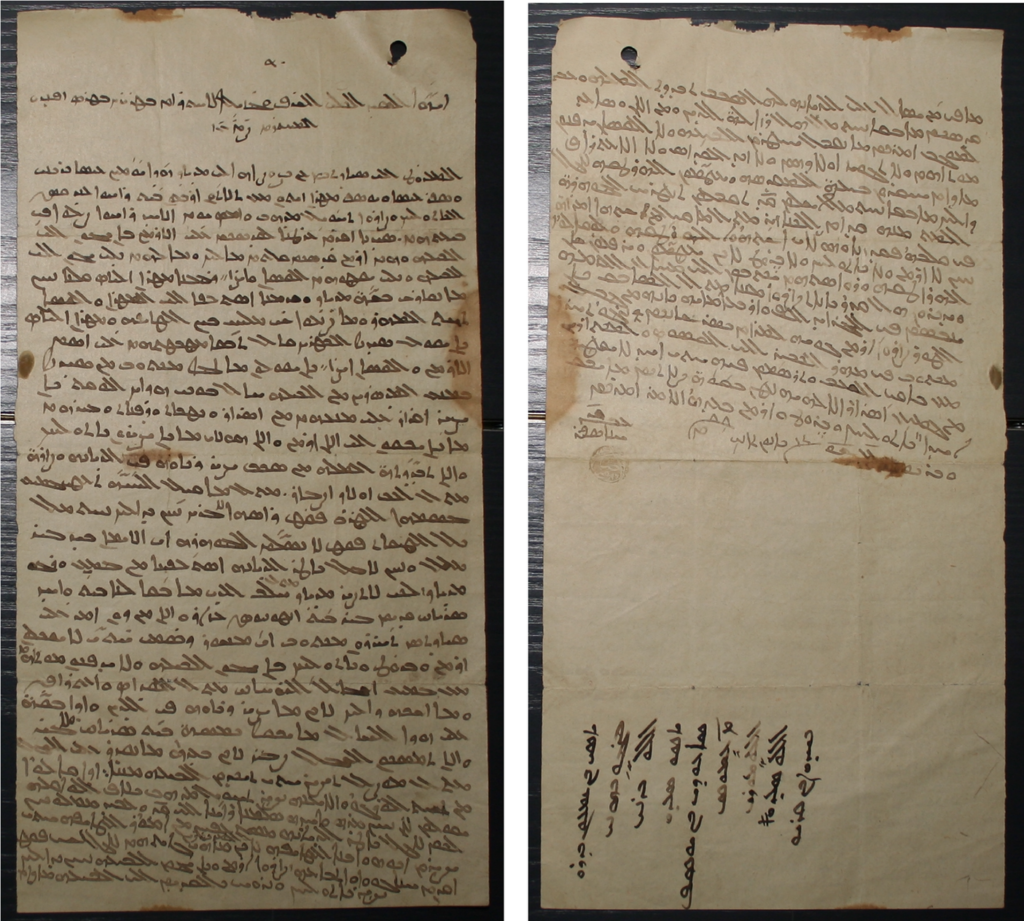
Figure 1. Hanna Safar’s letter to the patriarch, 12 January 1888.
It is difficult to say with certainty why the Syriac-Arameans that Hanna Safar referred to might have begun to identify not with the Syriac millet but with the Armenian or Catholic millets instead, though the reason may have been principally financial. While taxation under reformed Ottoman governance was meant to take place at the level of the individual—this in accordance with the Tanzimat reforms’ aim of instituting equality between all Ottoman subjects—in practice the millet leaderships were often involved in collecting state taxes from their community members on behalf of the Ottoman government (and were also authorized to collect special millet taxes to be put toward communal expenses). By identifying with a certain millet, an individual or group of individuals might be able to reduce their tax burden—if, for instance, that community’s leadership had negotiated a tax reduction or exemption with the local administration—or perhaps even avoid state taxes altogether if the millet with which they had identified themselves to Ottoman officials, say, was unaware of their millet membership and hence never came around to collect. To declare that one had “become” Armenian, Catholic, or otherwise, in other words, may have been simply an act of bureaucratic manipulation directed toward financial ends. These sorts of bureaucratic “conversions,” then, might not have attested to any real change in an individual’s identity, beliefs, or religious practices—and it was precisely this discrepancy between the “reality” of who the Syriac-Arameans were and the (to Safar’s mind) falsehood of their self-identification to the government that so disturbed the notable. Safar explained to the patriarch that many of the Syriac-Arameans who had supposedly “converted” (tahwil madhhab) to Catholicism, Armenianism, or Protestantism had not actually embraced these other communities/faiths but in fact continued to attend Syriac churches, receive baptisms, take communion, and sanctify their engagements and marriages with Syriac priests. They continued to fully participate, that is, in Syriac-Aramean communal life, merely refusing to identify themselves to the Ottoman state with the category that Safar saw as correctly nominating this way of life: “Syriac.” By identifying themselves as part of another millet to the government, Safar explained, these individuals were simply manipulating the new system of millet-based taxation to their own personal benefit. Their conversions, he held, were “contrary to reality” (khilaf al-waqiʿa). “Religion” (al-diyana) had become like a “game for small children,” with Syriac priests allowing anyone and everyone to enter the church, participate in the liturgy, and receive spiritual services, irrespective of how they publicly identified themselves to Ottoman state authorities. This represented a contemptible “religious laxity” (rikhawa fi-l-din) and a dangerous state of affairs. The reason that Safar found this practice of Syriac-Aramean misidentification so disturbing was that he understood, to a degree that the masses of Syriac-Arameans did not, what was at stake. He understood that, if the Syriac-Arameans did not maintain a material, documentary record of their communal existence within the domain of the Ottoman state—if they did not ensure that they identified themselves publicly as members of the Syriac millet—then the community (al-milla) would risk “dissipating entirely” (tatabaddad al-milla).
It is important to understand what exactly Safar meant by this. The immediate danger to which Safar referred—the reason that the Syriac millet was at risk of “dissipating entirely”—was not that the Syriac-Arameans were converting to other faiths, abandoning their Syriac-Aramean identity, or otherwise leaving the community in some way that marked them as no longer Syriac-Aramean or outside the communal fold. The people about whom Safar was concerned remained unambiguously Syriac, as they themselves, Safar suggested, would have acknowledged. The danger was rather to the category “Syriac” as the material guarantor of millet difference. It was to the capacity of the signifier “Syriac” to successfully coincide with the referent, the Syriac-Arameans themselves, a coincidence required in order to secure the forms of autonomy and freedom necessary to preserve the Syriac-Aramean way of life within post-Tanzimat Ottoman society. For Safar, it was therefore beside the point if the Syriac-Arameans who falsely identified themselves as Armenians, Catholics, Protestants, and so on, affirmed in private, to the patriarch, or among themselves that in truth they were “neither Armenians, nor Catholics, nor Protestants,” as they apparently sometimes did. If those same Syriac-Arameans continued to identify as members of these other communities to the state, then the leaders of those communities could write to Istanbul and report, as Safar suggested, that “this many houses have joined us,” adding to their own population numbers while eating away at the Syriac-Arameans’ own. Safar cited as an example that it had recently been printed in the papers that 1,400 houses in Tur Abdin—the heart of the Syriac-Aramean Ottoman population—had “become” Armenian. If the current situation were to continue, Safar warned, not more than five Syriac-Aramean houses would remain, and the vast Syriac-Aramean community of Tur Abdin would go the way of Aleppo, or Mosul, where over the previous century a mass defection to Catholicism had not only dwindled the Syriac-Aramean population but had allowed the Catholic millet to usurp Syriac churches as well. Safar recommended that the way to avert a similar such disaster in Tur Abdin would be to force the Syriac-Arameans to bring their public form of self-identification into accordance with the “reality” of the manner in which they actually lived—to force them to adopt the name “Syriac.” To do so, the patriarch should issue a general order to the priests, muhtars, and all other Syriac-Arameans forbidding anyone from giving or receiving the Holy Sacraments unless they renounced their identification with other millets and publicly avowed their Syriac-Aramean identity. Were the patriarch to issue such an order, Safar affirmed, “not a single Syriac-Aramean would remain Catholic, Protestant, or Armenian”—and the Syriac millet, perhaps, would be secured.
Five years after Safar had submitted his request to the patriarch, a second letter found its way into the ecclesiast’s diwan, this one signed by three men—notables, one assumes, given their seals—who were also from Tur Abdin. As had Safar, they used their letter to inveigh against a group of households that, under the leadership of a renegade communal leader whom they identified as Hanna Jawwo, continued to go by the name “Armenian”—this even though their self-identification as Armenian harmed the community’s standing in local government. More to the point, as far as the petitioners were concerned, their self-identification as Armenian was simply untrue. There is reason to believe that the three petitioners were concerned with the same population in Tur Abdin that had prompted Hanna Safar to write to the patriarch five years earlier. The patriarch had apparently intervened in the communal dispute in the meantime, and the petitioners thanked him for his efforts. But a faction asserting Armenian identity remained, and so the petitioners asked that the patriarch obtain a governmental order (emirname) prohibiting these houses from identifying themselves as Armenian to state officials. What came next in the petition is what I wish to describe as an archival “hiccup”—an intrusion into the archival record of an anxiety that attended the rise of the millet paradigm and the commitment to the reality of communal difference on which it depended. Petitions to the patriarch were often dictated to a scribe and written—or rather, recorded—in Arabic, even though the Syriac-Arameans of Tur Abdin tended to speak either Turoyo, a vernacular Syriac, or Kurdish. But Arabic was the lingua franca of Mardin, the seat of the patriarch, and the language in which the patriarch and his scribes conducted their correspondence. In this particular letter, however, the scribe appears to have encountered some difficulty in transcribing the petitioners’ words. In the middle of a sentence, the scribe switches from Arabic to Syriac, writing the Syriac words in Arabic script. The sentence in question reads: “We ask that you obtain an emirname from the government that prohibits them from saying that they are Armenians, because they are not Armenians but [here the switch to Syriac] mnhn wldy wldy wldy wldy [back to Arabic] Syriac.” The Syriac phrase “mnhn wldy wldy wldy wldy” is difficult to translate, but it seems to mean something like “we are the children of the children of the children of the children”—an emphatic assertion of generational continuity, of a lineage that stretches back through time. The petitioners, in other words, were insisting that the renegade Syriac-Arameans were not Armenians but Syriac-Arameans, and that this was so because they were the descendants of Aramean ancestors. The scribe’s switch to Syriac at this point suggests that the petitioners had themselves switched to Syriac when dictating this part of the petition, perhaps to emphasize the point or to express it in a way that Arabic could not. The archival hiccup, then, attests to the anxiety that suffused the millet paradigm: the fear that the reality of communal difference might not be as self-evident as it seemed, that it required not just naming but also proof, and that this proof might not be forthcoming.
Sources on the Hamidian Massacres (1894-1896) from a Syriac-Aramean perspective include unpublished memoirs by Safar Safar, alongside post-WWI memoirs by Chaldean Bishop of Mardin Israel Audo and Syriac Orthodox monk Abd Meshiho Naiman Qarabash, placed in dialogue with Ottoman, missionary, and diplomatic sources. Research has typically focused on Armenians as the primary victims, with Syriac Christians discussed peripherally, but contributions like those by David Gaunt (2006, 2018) introduce Syriac-specific narratives.
During the 1895 Hamidian massacres, Ottoman authorities formally aimed to strike Armenians while sparing Syriac-Arameans. Patriarch Mor Ignatius Aphrem I Barsoum records that on October 29, Syriac Orthodox notables Hanne Safar and his cousin Shakoro secured a pledge from the regional Turkish commander to protect the Syriac-Arameans per the vali’s directives. The officer kept his word, guarding Midyat and moving through nearby villages to drive off Kurdish raiders. This protection held from November 29 until April 1896, which is why Tur Abdin largely escaped the worst atrocities then reported from Hasankeyf to Mor Augin and from Cizre to Mardin.
In Tur Abdin, where Syriac Orthodox notables often aligned with the pro-Ottoman Dekşuri confederation, the Safar family were prominent, and around 1894 the council chose Hanne Safar to lead for four years. On his way to the investiture near Gercüş, the Kurdish agha Aliko ambushed him, arguing with backing from local sheikhs that a Christian could not take responsibility for their affairs.
Safar responded by asking why religion was being mixed into the confederation’s worldly business and what part of the job depends on the leader’s faith rather than competence; he added, “I personally do not see a good reason to withdraw my nomination because I am religiously different from you.” He then outlined that leadership meant coordinating cooperation and solidarity among the clans, preserving rights, defending border zones, curbing encroachment and predation, safeguarding pastures and water, protecting the territory from raids, and mustering aid whenever any member was attacked. A joint force of Kurdish tribesmen and Christian fighters quickly freed him, and his civic framing of the office won support from several Kurdish notables, consolidating his cross community legitimacy.
Early 20th Century and Sayfo (1901-1915)
Hanne Safar Pasha, head of the Safar clan, emerged in the late nineteenth century as the key Syriac Orthodox notable in Midyat. His family, originally from Kaʿbiye near Diyarbakır, rose after Midyat’s Christians helped Şevket Bey defeat the revived Bedirhan-led Bohtan coalition in the 1870s; in gratitude, Ottoman authorities granted the Safars an honorary pasha title and a ceremonial sword. Fluent in Ottoman Turkish, Hanne served as Şevket Bey’s adviser, coordinated Syriac-Aramean auxiliary forces, maintained an office in the district administration and sat on the council of the pro-government Dekşurî tribal confederation. In a region where his control was weak, Sultan Abdülhamid II cultivated local allies with medals and decorations; in Midyat he awarded Hanne Safar the Hamidi medal and other honours, recognising him as the official representative of the Syriac-Aramean community. Wearing his medals and ceremonial sword at public ceremonies, Safar exercised real authority over Syriac-Aramean affairs in Midyat and nearby villages, tasked with keeping the community loyal to the Ottoman state and curbing movements the government considered subversive.
Situated between state power and tribal politics, Safar operated within a landscape dominated by two major Kurdish confederations: the Dekşurî, centred at Arnes (Bağlarbaşı) and generally aligned with the government, and the Heverkan, split between the Hajo house at Mʿare (Eskihisar) near Nusaybin and the Çelebi house at Mzizah (Doğançay) near Midyat. Of the eighteen tribes around Midyat, eleven belonged to Heverkan and five to Dekşurî, and Safar’s family played a leading role in the latter. Around 1894 he was chosen to head the confederation for four years, but on the way to his investiture near Gercüş the Kurdish agha Aliko ambushed him, arguing that a Christian could not lead Muslim tribes. Safar replied that the post was a worldly office concerned with cooperation, protecting pastures and borders, defending members under attack and restraining predation, and that none of this depended on the leader’s religion. A joint force of Kurdish tribesmen and Christian fighters freed him, and his civic, non-confessional framing of authority helped consolidate cross-communal legitimacy among Kurdish notables.
During the Hamidian massacres of 1894–1896, Safar again used his position to negotiate protection for Syriac Christians. While central policy targeted Armenians, local implementation often threatened to spill over onto other Christians. Patriarch Mor Ignatius Aphrem I Barsoum records that on 29 October 1895 Hanne Safar and his cousin Shakoro secured a promise from the regional Ottoman commander, acting on the vali’s instructions, to safeguard the Syriac-Aramean population. Ottoman troops patrolled Midyat and nearby villages, driving away raiding bands, so that from late November 1895 to April 1896 Tur Abdin largely escaped the worst atrocities reported from places like Hasankeyf, Cizre and the Monastery of Mor Augin. This episode illustrates how Safar and other Christian intermediaries could, at least temporarily, leverage imperial connections and tribal alliances to shield their communities.
Safar, Hirmiz and Chalma Family Feud
Feuding between the Chalma and Safar clans in Midyat went back at least to the 1880s, when a young Safar notable named Use Safar was killed. Use strutted through the Midyat town center in Ottoman military boots, carrying a whip and nicknamed “Osmanlı” (“the Ottoman”). One day he whipped a horse in the middle of the town; the animal bolted, ran into a Chalma youth and sparked a fight in which Chalma men stabbed Use Safar to death. In local memory this became known simply as “Use badal Use.” Many Midyoye wanted to avenge him, but the Safar clan head held them back, so anger and resentment calmed down.
Due to the Safar family’s tight control over the Syriac Orthodox church of Mort Shmuni, tensions deepened. When the Syriac Orthodox patriarch intervened after Use Safar’s killing, Hanne Safar used his political–administrative influence to push for exile rather than bloodshed, and the Chalma accepted collective responsibility and were banished from Midyat—first to Mzizah and later to a place known as Qayasa in the southern part of Midyat, near the Yezidi village of Bajénne, where they were in exile until 1912. In exile, members of the Chalma family built houses in Qayasa and converted to Catholicism. The Chalma family became the most prominent family in establishing the new Catholic church east of Mort Shmuni in Midyat, which increasingly drew Syria-Arameans who felt excluded or unable to enter Mort Shmuni because of Safar dominance. After the exile of the Chalma family, Hanne Safar’s main political rival within the Syriac-Aramean community became Galle Hermez, a popular Protestant notable who served on both district and provincial advisory councils.
Early in 1915, as the First World War and the Seyfo approached, Safar stood at the centre of fraught attempts at communal defence. Christian leaders gathered in the church of Mort Shmuni, where Hanne, representing the Syriac Orthodox, and Galle Hirmiz, speaking for Protestants, joined priests and elders in swearing on the Bible to stand together. However, informers reported the pact, and the kaymakam summoned Safar, claiming that Protestants and Catholics—with alleged foreign ties—were endangered while Syriac Orthodox would be spared. Amid complaints that poor villagers were being asked to risk themselves for the wealthy Hirmiz clan, Safar withdrew from the alliance and assisted officials in arresting adult Hirmiz men. Over one hundred men from the Hermez family were then imprisoned and told they would face justice in Mardin, but they were killed en route and their bodies thrown into wells outside Astal, west of Midyat.
When the caravan had left Midyat, Galle Hermez turned to Hanne Safar and said:
“It is through your intrigues and those of your friends that I have ended up here. We are already condemned and will soon be in the world of the dead, while you and your fellow believers will continue to live on this earth. But it won’t be long before you too perish in the most cruel way.”
As rural attacks intensified in June, authorities ordered Christians to surrender their weapons and convened a meeting with Hanne Safar, Syriac Orthodox priest Isa Zatte, Kurdish headman Aziz Agha and gendarmerie chief Rauf Bey. In the countryside, massacres were carried out mainly by Kurdish tribal fighters and Al-Khamsin squads—about fifty older or exempt Muslims in uniform with state-issued arms—while regular troops intervened especially in garrison towns or where Christian resistance was expected. Central policy toward Syriac-Arameans remained deliberately opaque: unlike Armenians, who were subjected to deportations, Syriac-Arameans were generally killed in or near their homes, allowing provincial actors to wage a rapid, semi-secret campaign.
During the July 1915 assault on Midyat’s Christians, after governor Nuri Bey (who had been close to the Syriac-Aramean community) was replaced on the orders of Diyarbakır’s governor Mehmed Reşid, Hanne Safar was arrested. When news of his arrest spread, all of Midyat was terrified: for many it meant only one thing, that the Syriac Orthodox were no longer protected, and in the streets people began to shout “JIHAD!” Safar was then decapitated with his own ceremonial sword, and his head fixed to a pole and carried through the town. As the procession moved through Midyat, people shouted, “This is the head of the Syriac-Aramean leader in Midyat, take care of him,” and boys were given the head to kick like a ball. Amid the chaos, Syriac-Aramean Christian homes were plundered; looting swept through Christian neighborhoods, with houses stripped even of doors and windows, and at the Shaqfo market some children were thrown headfirst from a high roof. At the same time, the Heverkan tribal confederation split; the Çelebi branch under Sarokhano tried, with limited success, to protect Christians, while the Hajo branch under Hasan joined in the killings after its chiefs were released from jail.